
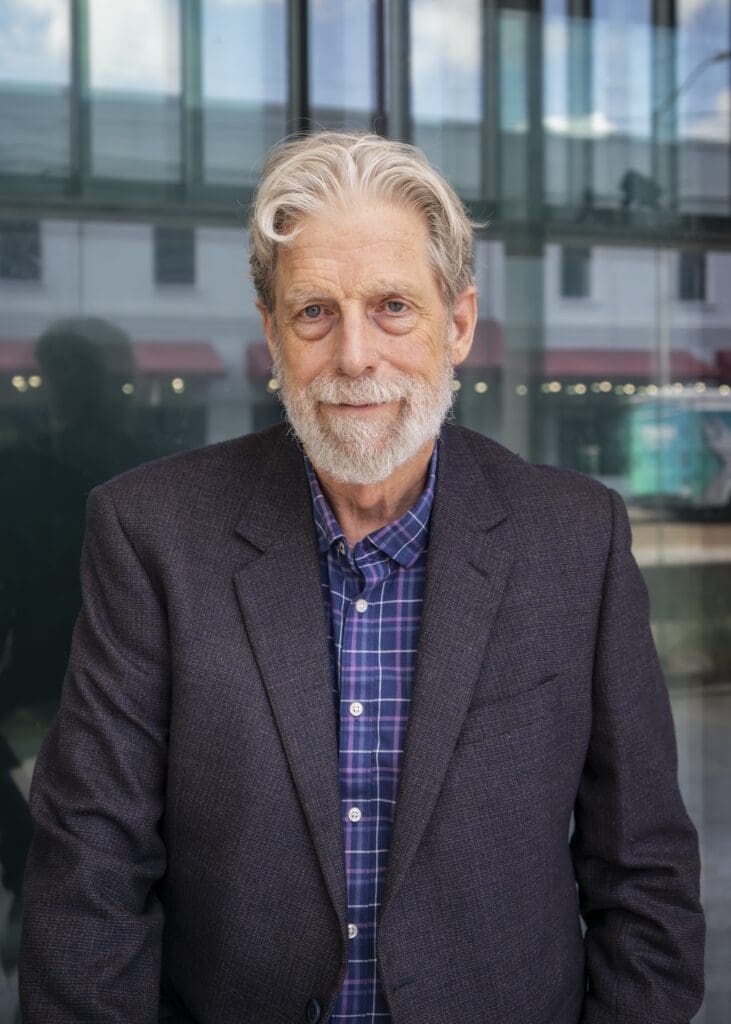
Meet Philip Gould – 2026 Pelican Ball Honoree
The riddle with documenting a thing is that the act of observing it changes that thing, its nature shifting under a watchful eye. A photographer’s presence, say, alters the way a subject exists and then appears in the final image made. The act of photographing something or someone will always include capturing at least a trace of the seer, somehow.
In order to net the most accurate, or honest, depiction of a moment, a photographer has to be the most unobtrusive observer he can be.
Photographer Philip Gould is ever-present (with camera in-hand) around the cultural watering holes of Acadiana and beyond, and has the ability to move unseen almost as a ghost would. Despite his slender 6’3” frame that stands in such contrast to the typically shorter Louisiana inhabitant, he can slip through a scene unnoticed.
Gould possesses the elusive gift of invisibility, a feat that requires humility and leads to more honest photographs.
The young man with a camera first arrived here in 1974 to fill a photojournalism job at the Daily Iberian when he was just 22 years old. He described his move from California to Southwest Louisiana as “the greatest cultural leap” a man could make within the continental US – leaving the bright and dynamic West Coast counterculture for what Gould refers to as the “foggy bayous and moss-laden live oaks” of New Iberia and its neighboring communities. His initial impression of a region of Louisiana we call Acadiana was that of a very singular culture experiencing a kind of awakening.
“When I first got here, what I saw was a culture that was very much aware of itself, conscious of who they were,” recalls Gould. “They were coming out of the trauma of the previous years where they’d been punished for speaking French.”
Recalling his first Saturday night in Louisiana, Gould recalls an image powerful and beautiful enough to bewitch any young visitor:
“I was taken to the Blue Moon Club in New Iberia. First impression you have, it’s a huge dance floor with a low ceiling, bandstand up there. The band was playing classic Cajun music, with walking bass and all that. Between songs the accordionist would rattle off in Cajun French a mile a minute. I was sitting at the bar, looking at the dance floor and you had all these people – old couples, what have you – and they were waltzing as one, moving across the dancefloor, holding each other in total sync. Looking across, you just saw all these bouncing heads, and it made this sense of gentle seas. I have not forgotten it.”
In a small town with very little big news going on, as he puts it, he had to often “beat the bushes” to find stories for the paper. Stories about people are what he enjoyed the most, and he recalls approaching regular people doing regular things where he could see potential in whatever living tableau caught his eye. He filled the Daily Iberian with daily images and full-page photo essays documenting what some might have found mundane, but that Gould found worthy of telling.
Did the people of South Louisiana trust this tall Californian with a camera in his hand?
“You’re holding up a mirror to them in a loving way,” says Gould, “and they are appreciative because you are showing that on some level you understand them.”
Photographic journalism fosters grit, patience, and a lot of practice – the perfect combination of conditions to produce – hopefully – the one perfect, essential shot. For Gould, one invaluable ingredient of his process is something most photographers don’t bring up – empathy.
“I try to be empathetic when I photograph,” says Gould. “I try to keep my photographic eye open but also consider what’s going on from their perspective. It keeps you honest, but also I think you end up with better photographs.”
French street photographer Henri Carter-Bresson referred to the decisive moment – the exact moment the visual and emotional elements of a scene align in perfect harmony. As Gould puts it himself, this is the moment that “both the compositional eloquence of the photograph and the informative and emotional quality are at a peak, and in this decisive moment both of them come into focus.”
At what point does journalistic photography start to become art? Is it when that decisive moment is captured in a frame?
Says Gould: “If art is the highest level of creative efforts, then photographs can be art. Why not?”
Since first landing in New Iberia over 50 years ago, Gould has exhibited his photographs nationally and contributed to over 20 books. He’s made books centered on his photographs of Louisiana’s legendary dancehalls, French train stations, bridges across the Mississippi River, and most recently aerial photographs of Louisiana’s landscapes and landmarks.
Gould recognizes the importance of cultural identity here in Acadiana, something he notes that nowadays is manifested primarily in creative output.
He credits the Acadiana Center for the Arts with making him understand the importance of creativity for everyone, not just those studying art at a university or children playing with fingerpaints.
“Creativity is one of the great joys of being human,” he notes.
Eventually he expanded his role as documentary photographer to the realm of public service by serving on the AcA board for 12 years, two of those years acting as board president. He joined the board at a time when the facility’s theatre was still under construction. He documented the building and finishing process with his camera, and was present for its very first concert performance (and many others since then).
After his healthy stint at AcA, he went on to serve on the advisory board for Downtown Lafayette Unlimited where he still sits.
DLU’s current CEO Kevin Blanchard calls Gould one of our community’s “essential voices” whose generous spirit and cultural fluency have gifted us an unparalleled documentation of who we are.
“Taken as a body of work over the decades, Philip’s images are like the marks parents make on the door frame each year to show their children’s growth over time,” says Blanchard. “We can look back through his eyes and see where we came from – and where we are going.”
How does Louisiana present as a muse for Gould’s work, after all these years?
“It’s a subject that just keeps on giving,” he says. “In that regard, it is a generous subject. Every time I turn around, something else appears.
“I say that in a karmic sense – if you’re on the right side of karma here, Louisiana answers back.”
Written by Brooke Broussard